Overview
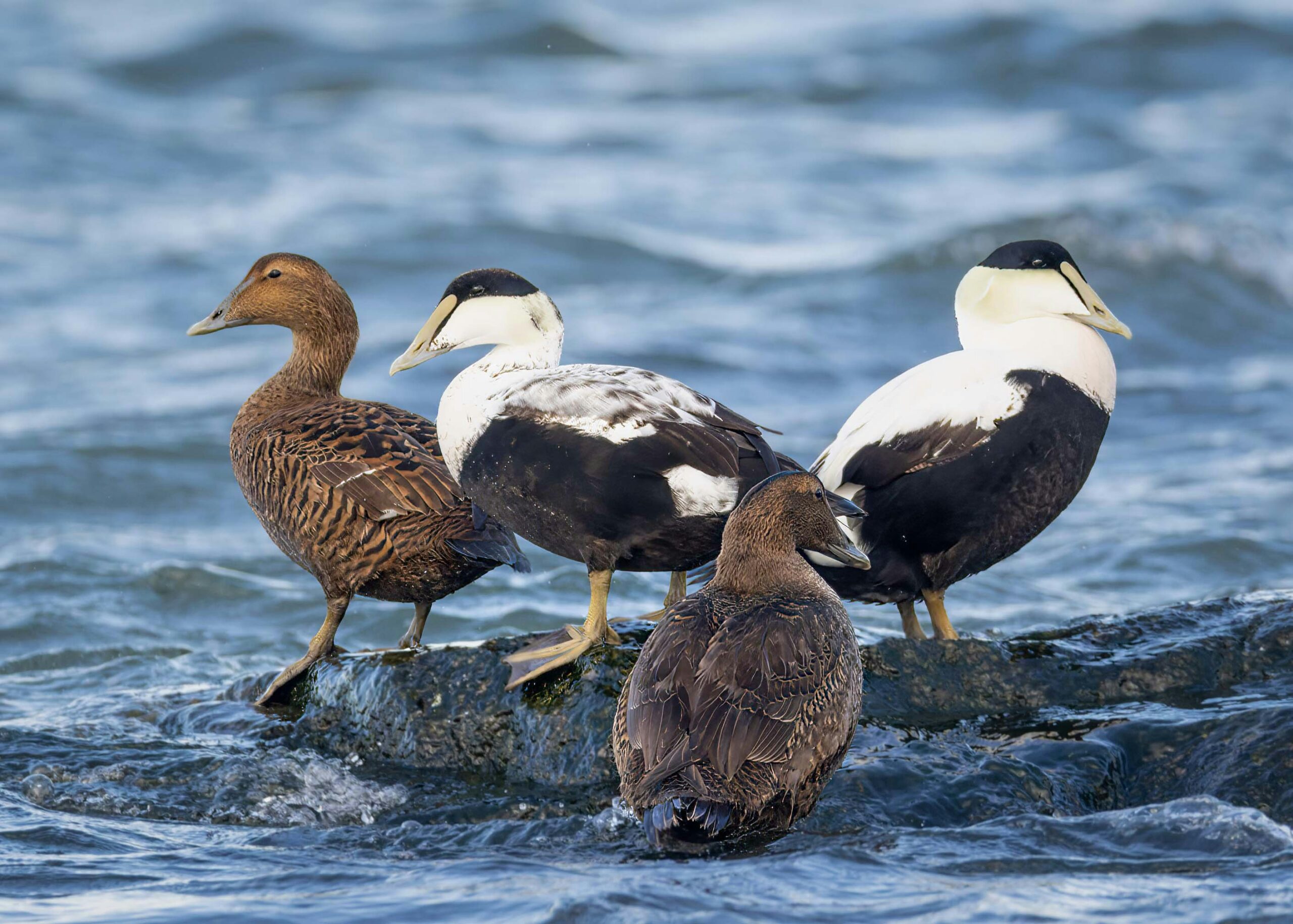
The Common Eider (Somateria mollissima) is one of the North’s most iconic sea ducks—big, social, beautifully patterned, and deeply tied to coastal ecosystems and human culture. Here’s a complete, structured profile grounded in the latest information.
A large, heavy-bodied sea duck found across the northern coasts of Europe, North America, and eastern Siberia. It breeds in Arctic and subarctic regions and winters slightly farther south on cold coastal waters.
Distribution & Habitat
Breeding: Arctic islands, tundra coasts, rocky shorelines
Wintering: Cold coastal waters just south of breeding range
Often forms huge flocks—sometimes thousands—offshoreIdentification

Adult Male
Mostly white body with a green‑black head
Black back, white inner wings
Long, narrow red bill
Sleek, powerful profile
Adult Female
Gray body, rusty‑brown head with a ragged crest
Sharp white chin patch
Clean border between head and breast

Size
Length: 58–72 cm (23–28 in),
Wingspan: 78–97 cm (31–38 in),
Weight: 0.9–2.1 kg (2–4.6 lb)
Diet/Foraging
Primarily marine invertebrates. Specializes in mollusks (especially mussels), and dives to the seafloor, sometimes in strong currents
Breeding & Nesting
Nests on coastal islands, often in dense colonies. Female lines the nest with eiderdown plucked from her breastChicks leave the nest within 24 hours and feed themselvesFemales often form crèches—groups of many ducklings guarded by multiple females.
Migration
Common Eiders are resident to medium‑distance migrants, depending on the subspecies and region. Some populations barely move at all, while others travel hundreds or thousands of kilometers between Arctic breeding grounds and more temperate wintering coasts.
